Procurement notes
Fuel Off Road Alloy Wheels Sourcing: A Scenario Guide to China Suppliers
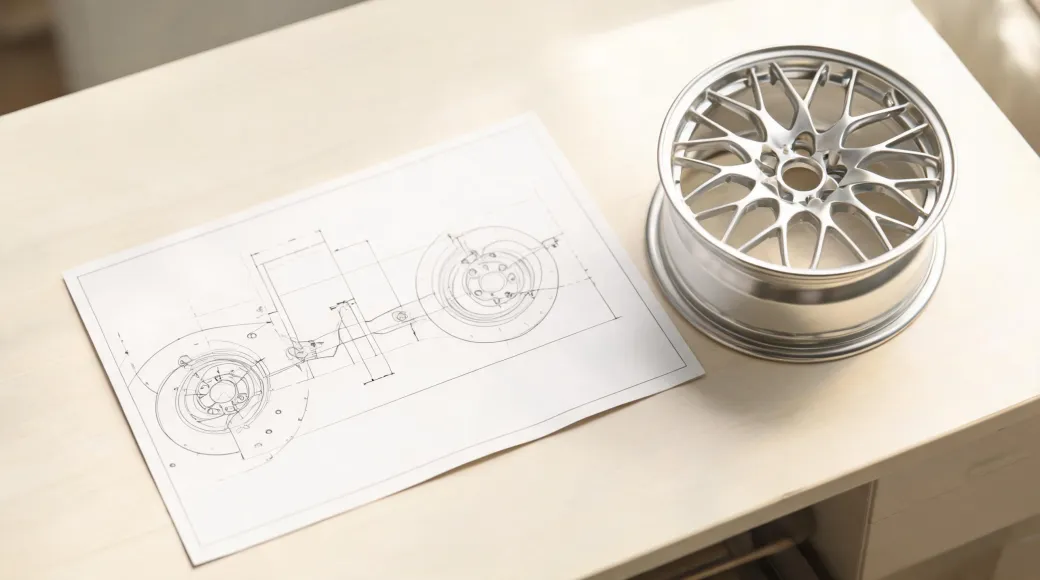
If you just searched "what are alloy wheels sourcing" — the short answer is: it's the process of buying alloy wheels where the spec, load rating, and tolerances are verifiable, not just the price and the fitment chart. And "where to find alloy wheels suppliers in China" depends entirely on which sourcing problem you're solving.
I'm a quality and brand compliance manager at a wheel distribution company. I review every batch before it ships to customers — roughly 400 wheel orders a year, not counting the samples I reject outright. In 2024, I turned back about 11% of first shipments for cosmetic or dimensional drift. That habit has left me with one stubborn opinion: there is no single "best" alloy wheels supplier in China. There's only the supplier that fits your scenario.
It took me three years and about 400 wheel orders to understand that sourcing from China isn't about finding the best factory — it's about finding the one whose written spec and actual shipment match. That's a different thing, and most buyers don't learn the difference until they get burned once.
Why "where do I find suppliers?" is the wrong first question
Most buyers searching "alloy wheels suppliers in China" or "Fuel Off Road alloy wheels sourcing" start with the wrong question. The right first question is: what kind of procurement problem are you solving? The answer changes your supplier criteria, your negotiation posture, and your contract clauses — sometimes dramatically.
I've watched buyers reject a perfectly good supplier because they evaluated it against the wrong scenario. They walked away from a factory that would have been a strong partner for standard catalog replenishment — multi-spoke, black or machined finish, 17-inch and up — because they treated it like a custom-mold project. The reverse happens too. Someone treats a one-off replenishment order like a long-term relationship and ends up paying for flexibility they don't need.
The three sourcing scenarios
In my experience, most Fuel Off-Road-style alloy wheels sourcing decisions fall into one of three buckets:
- Scenario A: You already have a supplier relationship and need to extend the line, add SKUs, or build a backup.
- Scenario B: You're launching your own brand or private label and need a partner for custom finishes and branding.
- Scenario C: You're sourcing from China for the first time and need a baseline without getting burned.
Each one has a different center of gravity. Let me walk through them.
Scenario A: Extending an existing line (or building a backup)
If you already stock Fuel Off-Road-style wheels — spoke designs, black or machine-finish, 17-inch and larger off-road fitments — your priority is reproducibility, not exploration. You aren't shopping for the cheapest option. You're shopping for the supplier whose third shipment looks like their first. That's why vetting a Fuel Off Road alloy wheels supplier is a reproducibility question, not a price-sheet question.
This is where the value-over-price math gets concrete. A supplier quoting 8% less per unit can cost you more if the finish drifts from matte to semi-gloss between runs. I've rejected a 200-piece shipment because the "black" didn't match the retained reference under controlled lighting — the buyer ate the freight and re-ordered inside two weeks to keep a waiting customer. The 8% savings evaporated against a 30% emergency air-freight premium and a delayed re-supply. As a rule: when one quote sits noticeably below the rest and the spec is written, the gap usually comes from something outside the spec — finish, packaging, or inspection depth. Check the spec, not just the number.
Questions to ask this supplier:
- Will repeat orders come from the same mold and line, or will it be re-tooled?
- What's your finish-consistency protocol between batches?
- Can I keep a retained physical reference from the first order and treat it as the standard?
- What's your declared tolerance on bore, offset, and PCD — in writing, on the parts I'm buying, not printed in-house?
Scenario B: Launching your own brand or private label
Here's the part most buyers miss: if you're building a brand, you aren't looking for the cheapest factory. You're looking for the one that will make the most consistent version of your spec and will protect your brand when something goes wrong. Your brand lives on perceived finish quality and on how fast you handle a defect complaint compared with a competitor.
This scenario justifies a higher unit price. What you're buying with the premium is flexibility on MOQ for custom finishes, written cosmetic inspection criteria, and packaging that doesn't leak the factory's name onto your brand. I'll admit I resisted this for a while — I used to file every premium under "marketing mark-up." It isn't. You're paying for documented inspection standards, and those are what keep your defect rate from becoming your brand's reputation.
Questions to ask this supplier:
- Can cosmetic inspection criteria (AQL limits, surface-finish standards) go into the purchase order as written terms?
- What's your process for retaining golden samples and calibrating new production against them?
- Will neutral packaging and neutral documentation be standard on every shipment?
- What's the defect-handling protocol — credits, replacements, or both — written into the contract?
Scenario C: Buying from China for the first time
First-time buyers usually focus on the wrong risk. The obvious risk is a bad sample. The bigger risk is assuming a good sample predicts shipment three. Most factories can make one good sample; that's what the sample process is built to produce. The real test is repeatability after a tooling change, a finish change, or a personnel shift.
Start with a staged process, not a single bulk order: sample validation, a pilot order of 50–100 pieces against a written spec, then a scale-up decision. You'll pay more per unit on the pilot — that's the cost of information. I reviewed a case where a buyer ran two pilots before committing to a 2,000-unit production run. The second pilot ran about 18% higher per unit than the quoted bulk price, but it surfaced a bore-tolerance drift that would have produced shimmy complaints once those wheels hit road use. The 18% premium bought the confidence to sign the bulk order instead of the sample.
Confirming that pilot order, I immediately wondered whether we should have pushed straight for bulk pricing. Didn't relax until the second shipment arrived with every dimension inside tolerance. In hindsight, that was money well spent.
Questions to ask this supplier:
- Can I see your recent production history for this specific wheel — actual shipments, not samples?
- What are your declared tolerances on bore, offset, PCD, and load rating?
- Which standards does your line follow, and can I see third-party documentation for the specific parts I'm buying?
- If inspection fails, what happens — rework, scrap, or ship with a note?
How to tell which scenario you're in
These are the three questions I use to classify a buyer — including myself when I'm scoping a new program:
- Do you have a retained physical standard from a current shipment that you want the new order to match? If yes, you're in Scenario A. Your contract should be built around matching that standard.
- Will the wheels ship under your name, your packaging, or your finish schedule? If yes to any of those, you're in Scenario B. Your contract should be built around documented finish and packaging standards.
- Are you still deciding whether this category is worth entering? If yes, you're in Scenario C. Your first order should be built to buy information, not volume.
There's a fourth, less common scenario: you're replenishing in an emergency — a customer is waiting and your current supplier is late. That isn't a sourcing scenario, it's a risk-mitigation scenario, and the criteria change again. You pay for speed and certainty, not for price. I keep it separate because the buyer's instinct in an emergency is to compare quotes, and that instinct is usually wrong.
One compliance note that applies to every scenario. Under NHTSA's FMVSS No. 120, replacement wheels sold in the US must meet specific strength and performance requirements to be legal for highway use. Ask the supplier for third-party test documentation on the exact part number you're buying — not a factory-wide "all our products pass" claim. The same discipline applies to JWL (Japan), TÜV (Germany), and SAE J2530 for aftermarket wheels. A reliable alloy wheels supplier won't dodge the question; they'll already have the documents ready.
Whichever scenario you're in, the decision you're making isn't "which supplier is best?" It's "which supplier is best for the situation I'm actually in?" Get that wrong and you'll optimize for the wrong thing — paying for flexibility you don't need, or locking into a contract that doesn't fit your reality. Before you commit a bulk order to an alloy wheels supplier, make sure the scenario is right. The lowest quote in any of these cases is rarely the lowest total cost. It's just the lowest starting number.

Jane Smith
I’m Jane Smith, a senior content writer with over 15 years of experience in the packaging and printing industry. I specialize in writing about the latest trends, technologies, and best practices in packaging design, sustainability, and printing techniques. My goal is to help businesses understand complex printing processes and design solutions that enhance both product packaging and brand visibility.